

Setting your 2026 goals
At a time of the year when good resolutions tend to fail, here is a proven system for setting and following up on your goals

I do believe in planning, as that’s how we become increasingly intentional with the use of our time.
At the same time, I don’t believe in the popular ‘new year’s resolution’ approach, as it tends to be based on wishful thinking, lacks a system to ensure you’re setting reasonable goals, and that you’ll be following up with them.
Even when people have a system for setting their goals, I see them falling into two common pitfalls:
They set too many goals, and lose focus and the ability to make significant improvements
They tend to focus entirely on one dimension or area, typically their job, forgetting that our professions are only a part of a meaningful life and should contribute to it, not the other way around.
During December, I held two sessions with the members of the Sudo Make Me a CTO Community in which I guided them through the process of setting their 2026 and then their Q1 goals.
In today’s article, I’m going to illustrate the process we followed.
If you’d rather watch the recordings from the community sessions, you can sign up today and gain immediate access to all past sessions. That’s also a great way to support this newsletter!
I do recommend you first read the whole article to get a sense of the process, and then set aside some time to follow the approach, as this will require quite a bit of work on your end if you really want to get good results.
You should block 60 to 90 minutes for the whole exercise.
The 4 buckets of life
As already mentioned, we often tend to focus exclusively on our job or career, forgetting that it’s only one dimension of our lives. Health, relationships, and betterment of self are all important aspects of a life well lived. Cal Newport, an author who has been influential in shaping my perspective on planning and intentionality, has introduced the concept of the 4 buckets of life: Constitution, Community, Craft, and Contemplation.
They can roughly be described as follows:
Constitution: Anything that has to do with health, fitness, mental state, or overall physical well-being.
Community: Connection and relationships with family, friends, networks of shared interests, etc.
Craft: Our professional aptitudes related to our current job, career development, leadership skills, technical skills, etc.
Contemplation: This one has to do with cultivating our values, hobbies, spiritual life, or more general personal improvement through educating ourselves in topics unrelated to our careers.
One of the first mistakes people make when they set goals, and even more when they don’t, is that they tend to focus on the Craft bucket and sacrifice, deliberately or accidentally, all the others.
That's why in the following steps, we'll be looking at all four of them.
Look back at 2025
The best way to understand whether you’ve been dedicating a reasonable amount of energy and attention to each one of the buckets, the goal-setting exercise for 2026 must start with a bit of retrospective.
Take a piece of paper or an electronic document, and for each one of the 4 buckets mentioned above, write down the following assessment:
Overall rating: Assess your satisfaction with the progress or overall situation with the bucket during 2025. Do you feel you dedicated enough time and attention to it? Do you think you’ve been neglecting it? Rate it with a score from 1 to 5, with 1 being the lowest level of satisfaction. Nobody else is going to see this, so do not lie to yourself. The more honest you are, the more helpful this exercise will be.
Energy Gainer: What is one thing that gave you energy in this bucket during the last year?
Energy Drainer: What is one thing that drained your energy in this bucket during the last year?
Once you’ve done this, look at your lowest score, and think about why things went the way they did, and what it would have taken for you to give a higher score. This first reflection should inform and influence how you're going to look forward at the following period.
Setting the 2026 Yearly Goals
Now that you’ve come to terms with your 2025, let’s switch our attention to the future. We will run through a few iterations to draw your final list of goals for 2026.
The first step takes a common expansive approach.
For each one of the four buckets, write down a list of 3 goals, things you would like to achieve, in 2026. Make sure you frame them as outcomes, not as activities. Use the SMART approach to ensure those are “good” goals1.
As an example, “exercise more” is not a good goal. “Run a half-marathon before the end of the year” is. Similarly, “write more code” is not a good one. Instead, “Make a PR contribution to open source projects at least once per month” is a good one.
After about 15-20 minutes, you should have a list of your 12 goals for 2026. Congrats, this is an important step, but we’re far from done!
Do you remember when, in the introduction, I mentioned that we have the annoying tendency to choose too many goals, setting ourselves up for failure? Trying to achieve significant results on twelve different goals in a year falls in that category.
I want you to be ruthlessly prioritising, and that requires you to sacrifice things. Without it, you'll still end up having to sacrifice some of them, but you'd be doing it reactively, and typically sacrificing the important for the urgent. The advantage of early prioritisation is that you will be deciding up front what you think is worth sacrificing, and what you want to protect at all costs. Again, planning is an exercise in making a more deliberate use of your time.
So, take that list of 12 goals, and for each one of the four buckets, identify the most important one. Not two or three. One. Circle, underline, or highlight them. These are now your four goals for 2026. That’s a lot more tractable than the original list of twelve!
What should you do with the remaining 8 goals?
You should treat them as an “Avoid at all costs” list2. While still interesting, these goals can become dangerous distractions. They are the common source of productive procrastination, which we typically pick up whenever we’re struggling to make progress on our main goal. Ensure you stay away from them at least until you have achieved your primary goal.
One more thing: though four goals in a year seem to be a reasonable target, life has an irritating tendency to throw curveballs at us.
When the proverbial shit hits the fan, you will want to focus all your energy where it matters most. For this reason, I do recommend you take an additional step in finalising your yearly goals. Look at the four goals you’ve set, and ask yourself the following question: if something happens that will take away a lot of my energy (and most likely it will), which one of these four goals and buckets I am willing to sacrifice? Think about it, and mark the one that you would be willing to temporarily neglect or drop completely if something unexpected occurs.
At this point, you should have a nice list of 3+1 goals for 2026. Seems doable, right?
Yes, unless you do as many people do: stop here, and forget about the goals until you get to the end-of-year retrospective.
Setting Quarterly Milestones
The yearly horizon is great to set meaningful goals, but it’s too far away in the future to be actionable on a smaller scale. That’s why it’s important to plan on multiple horizons. While we’re going to explore some aspects of a full system in the following paragraphs, I do recommend you also read the article in which I illustrated the whole system I use to plan and execute at multiple time scales.

A good way to think about different time horizons is illustrated in the following picture
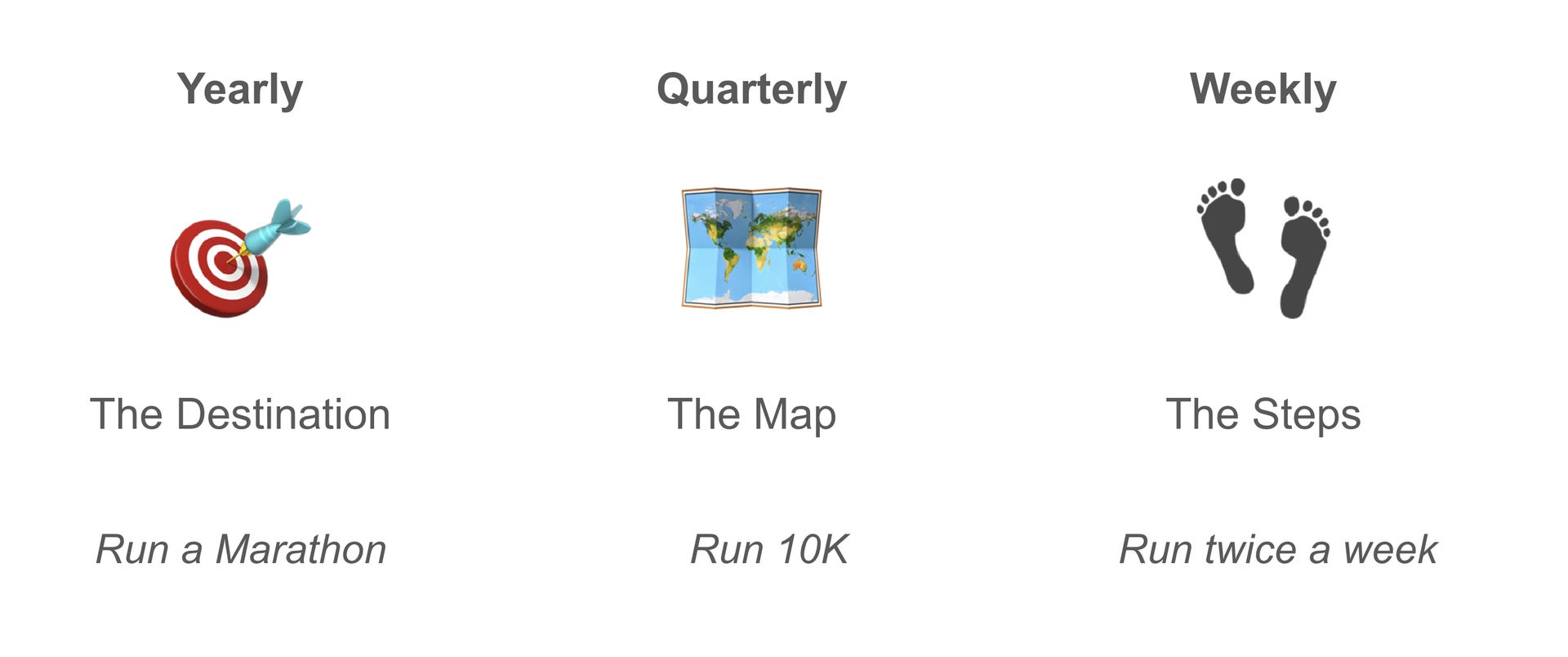
Now that you have your list of four goals for 2026, I want you to bring them down to the quarterly level first, and later to the weekly horizon.
Let's tackle Q1 first.
For each one of your yearly goals, you should identify the key milestone for Q1. What’s the single most important milestone you want to achieve by then? Achieving is the keyword here. These should be measurable outcomes, similar to the ones you set at the yearly level, but more granular and likely incremental. See the picture above with the marathon running target for an example.
An example from the Craft bucket that would be relevant for you could be the following:
Yearly Goal: Define, socialise, and get buy-in on an updated tech strategy for our company for the next three years
Q1 Milestone: Have a set of Wardley Maps and a Domain Map covering all business aspects of our company, produced with the contribution of all Staff+ and Managers in the team, key stakeholders, and business domain experts.
I’m making things up, of course, as depending on your situation, taking a year to develop a strategy might be completely unreasonable. It’s an example to make it more relatable, not a suggestion or recommendation.
It’s important to note that you will need to repeat this part of the exercise every quarter. I do recommend doing it in the last couple of weeks of each quarter.
So far, we’ve covered the what to achieve part, but not how to get there.
That's what we'll be focusing on next.
Building the System
Having a system is essential to ensuring you’re actually going to deliver and make progress on the targets you’ve set for yourself.
You can come up with something very sophisticated, but in its simplest for,m such a system will require two elements.
The first one requires you to set aside time for making progress on your goals. I want you to look at your calendar and think about how you can structure your ideal week so that you have recurring time slots in there to make progress on your quarterly goals.
This should become your template for the ideal week, to which you'll be making adjustments as needed when you plan each week. My recommendation is to set aside specific recurring blocks on your digital calendar and have them reserved in advance. Alternatively, you can settle for writing down a set of rules you’ll be following through the quarter, in the same place where you have defined your goals.
For example, you could have something like the following list of rules.
To hit my goal of developing a comprehensive strategy for my team, I’ll block 2 hours first thing in the morning every Tuesday and Thursday.
Every other Thursday, I’ll have dinner out with my partner.
On Monday, Wednesday, and Friday morning, I’ll take a 1-hour walk in the park
One advantage of blocking these directly on your calendar is that it keeps you real, as you quickly see if you’re trying to cram too much stuff on it. If this is the first time you try this exercise, I do recommend you start small and increase the ambition level as you gain more practice and confidence.
The second part of the system is a recurring check-in on your goals. You need to answer the following simple question: how and when am I going to check in with my goals?
I do recommend finding a weekly slot and putting it on your calendar. This space will be fundamental for you to assess whether you’re making progress, whether your schedule is working, and whether you need to make any changes to it.
That's it, now you have your system in place and are ready to get cranking on those goals.
Get going!
If you’ve followed along, at this point you will have:
4 (or 3+1) yearly goals for 2026
4 Q1 2026 goals
A few key weekly habits booked on your calendar, ideally one per bucket
A weekly check-in routine
The hard part begins now, and it’s about building the discipline to stick with your goals and system once the initial excitement has tapered away. I do recommend you share your goals and efforts with others to help you find accountability partners. That’s what we’ll be doing in the Sudo Make Me a CTO Community, where we’ll be checking in with everyone’s goals once a month during our live sessions.
Making this journey together with others increases your chances of success. If you're really serious about achieving your goals in 2026, you might want to consider joining us to benefit from this additional support.
I wish you a great 2026, one in which you’ll make significant progress in all areas of your life that matter!
Help keep this newsletter free
I love writing this newsletter, and I intend to keep it free forever.
If you want to support my work, you can engage with me in one of the following ways:
If you need help with your Startup, Company, or team, I can support through advisory or fractional services. Find out more on this page.
If you need personal support to overcome challenges and grow as an engineering leader, I can support you through Mentoring and Coaching. Find out more on this page.
If you are looking for continued support and the chance of joining a thriving community of like-minded people, I host a Community for engineering leaders. Find out more on this page.
If your needs fall into a different category, such as newsletter collaborations or sponsoring, please reply to this email or schedule a free call via this link.