

Postiz has a slop problem
How the guy who's selling cocaine to friends and family is complaining about the junkies showing up in their lovely neighbourhood. How dare they!

A recent post in the selfhosted subreddit caught my attention.
It’s from the creator and maintainer of Postiz, and this is what it says.
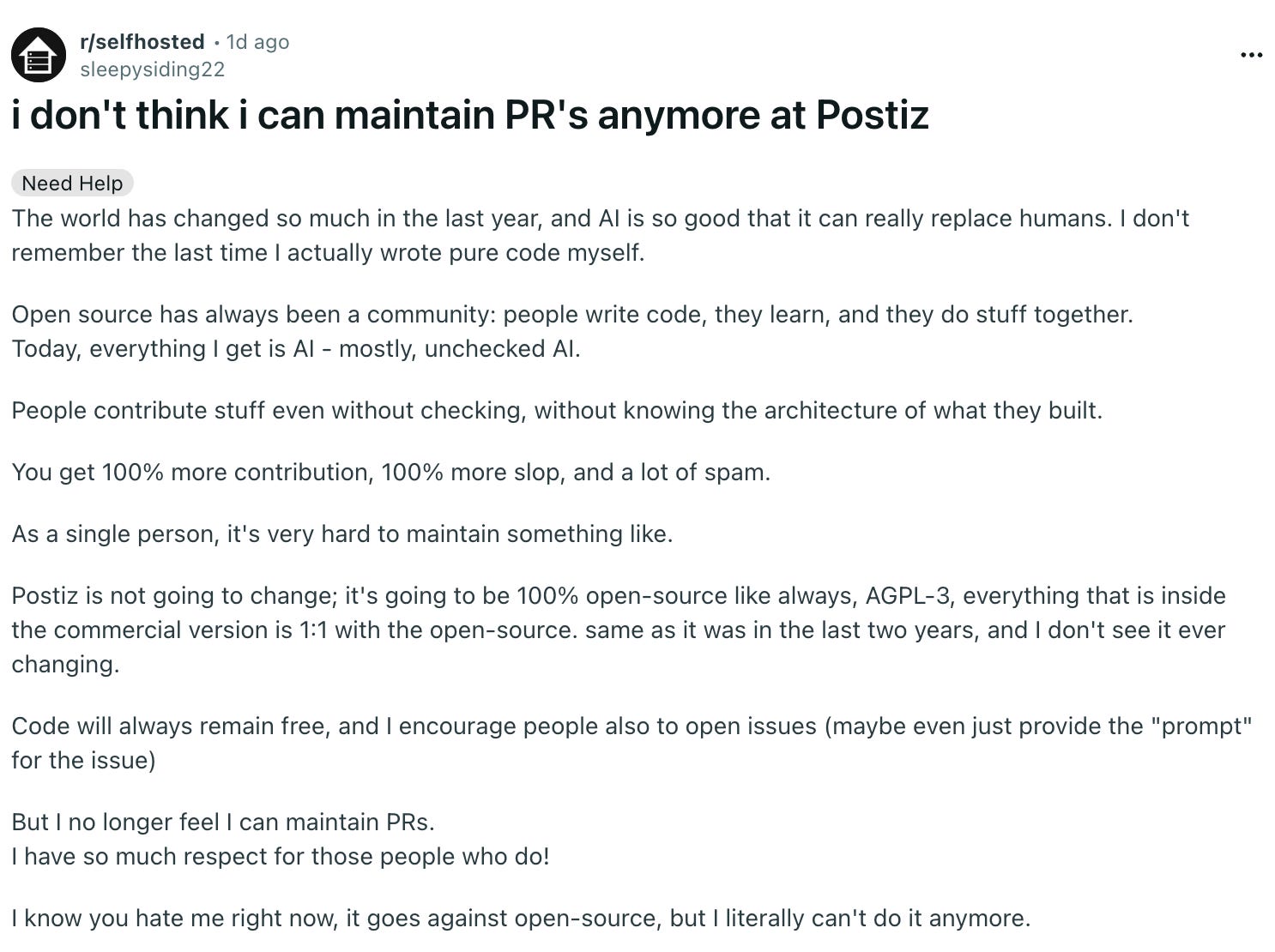
At first this looks like many of the cries for help we’ve seen coming from many maintainers of popular open-source projects, such as curl or Gostty.
But when you look at it more closely, things become a lot more… interesting.
Let’s start with what Postiz is, how it markets itself, and what its main use cases are.
Before we get into the core of the article, I have an important announcement to make. On April 16th at 5PM CET I'll host an open session of the Sudo Make Me a CTO Community. It will be like one of the regular sessions reserved for members of the community, except that it will be open to anyone for attendance!
If you're interested, sign up here and you'll receive an invite shortly after.
It's free. It will only cost you one hour of your time.
In case you want to know more about the community, check it out here.
Now, back to the article.
What even is Postiz?
I happened to know Postiz from before I saw the Reddit thread, but I’m pretty sure most of you don’t. I even tried it out for a while and stopped using it shortly after. For reasons that will become apparent as you go through the article.
If you go on Postiz homepage you’ll be welcomed by a bold title selling the dream: “Your agentic social media scheduling tool”.
Agentic, you say? Hmmm, I’m already scratching my head.
The best part, though, is in the hero video that plays in a loop on the landing page. If you decided to watch it, like I did, it’ll give you plenty of clues about what the product can do. And not just that, but also how the original author wants it to be perceived.
Such as the following gem:

On the same page, you’ll see the AI Content Assistant and Design with AI features prominently promoted.
So, what is Postiz exactly?
In pre-2022 terms, it would have been labelled as a simple "social media scheduling" tool, like Buffer and other similar platforms.
In today’s terms, it’s a slop machine.
If the first page you see about the product when visiting its home page wasn’t enough of a statement, you can also find an entire page dedicated to the groundbreaking CLI (command-line interface) companion for Postiz, aptly hosted under the /agents page. The CLI facilitates seamless integration with OpenClaw and other similar tools.
All that seems like a big endorsement for the dystopian, slop-fuelled future promoted by the handful of well-known Silicon Valley broligharchs.
But maybe it’s just me misinterpreting.
Maybe, according to Hanlon’s razor, this might be a case of incompetence rather than malice on the side of Postiz's maintainer.

And to be clear, I have nothing against Nevo, Postiz's author.
I genuinely found his request for help compelling, and that forced me to go deeper on the case. He seemed so much in distress that I wanted to provide my support.
But then I did what anybody else would do in search for more context: I checked other Reddit posts from him.
Hidden among the not-so-occasional spam messages that got banned/removed, likely due to some good old dogfooding, there are some true gems.
Such as this one titled, Anyone who has a SaaS must double down on OpenClaw. A couple of quotes taken directly from it:
In general, whenever there is big hype, even if you don’t like it, it’s very worthwhile to check whether you can take advantage of it. [Emphasis not mine]
and
Now with OpenClaw, anyone who deploys it can simply write in a few words what they want.
This is when I stopped feeling compassionate and got really annoyed.
So, yes. Postiz author has been deliberately building a slop machine for the best part of the last two years. Making it easier for “content creators” to just generate garbage content and spam all sorts of platforms and social networks. They’ve not only been deliberate, but they’ve actively encouraged other people to do the same. And now, out of the blue, they come out complaining about the slop code suddenly flooding their PRs pipeline.
To paraphrase what I shared as a reaction: if you like to sell cocaine to friends and family, don’t be surprised when your nice and cosy neighbourhood starts attracting junkies.
Besides the fact that GenAI/LLM-related situations are almost perfect matches for drug-related analogies, what’s going on with Postiz is a textbook example of a tragedy of the commons type of situation.

So, instead of singling out Postiz's case, which is not the main goal of this article1, I’d like to look at the more general problem here.
Tragedy of the commons
According to Wikipedia2, this is how you could define this concept:
The tragedy of the commons is the concept that, if many people enjoy unfettered access to a finite, valuable resource, such as a pasture, they will tend to overuse it and may end up destroying its value altogether.
It is often mentioned in the system’s thinking theory, as it applies to many real-world situations: the supply of fresh water, oil, coal or even the issue of overfishing. These are all cases where short-term incentives can cause feedback loops to get out of control and reach “escape velocity” to the point of no return.
Environment- or finite resource-related examples are the most frequent examples of tragedy of the commons, but it is my belief that the digital era has introduced a whole new class of them.
Take the case of Airbnb and its effects on the cost of housing in popular city centres. The short-term incentive, i.e., making money out of apartments (for sellers) and getting cheaper accommodation compared to hotels (for the buyer), led to massive mid- to long-term nefarious effects: acceleration of gentrification, housing crisis, and overtourism.
In fact, when it comes to the adoption, and even more so with the promotion, of GenAI-assisted tools in software development, for a long time I used an analogy that felt right but, in retrospect, lacked more nuance. I used to say that software engineers enthusiastically embracing GenAI-assisted tools in their workflow are like taxi drivers who would ride on Ubers for their own personal travels. Jeopardising their future for the sake of short-term savings or convenience.
Being penny-wise and pound-foolish, as someone would put it.
That was based on the relatively simple idea that promoting the adoption of GenAI-assisted tools in software development would help improve them to the point they’d end up replacing the person using them in the long run. In other words, software engineers would serve as a flesh-and-blood version of training data.
It’s true that some managers are making silly decisions to fire people “due to AI”. But those decisions are largely disconnected from the actual work these tools can do when compared to humans. Anyone who is five years old or older and with a mildly functioning brain will understand that what Jack Dorsey made look like AI-driven layoffs of 4000 people is little more than AI-washing3.
But the real problem we’re observing with the Postiz case is a lot more nuanced than that. It has to do with what is known as the normalisation of deviance4. This phenomenon is often mentioned in relation to major disasters, such as the Space Shuttle Challenger disaster. According to the corresponding Wikipedia page5, the American sociologist Diane Vaughan defines it as follows:
the process where a clearly unsafe practice becomes considered normal if it does not immediately cause a catastrophe.
A single person posting slop on a social network doesn’t cause any immediate impact.
When multiple people do this repeatedly, it causes catastrophe: a world in which it has become normal to produce and consume garbage. Actively engaging with your brain has become a frowned-upon activity. A world in which it is not only socially acceptable but also socially encouraged to take advantage of whatever the latest hype wave is, to quote Nevo’s unfortunate Reddit post, otherwise someone else will do it (and we’re back to the tragedy of the commons).
In case you haven’t noticed, this is exactly what happened with tobacco for the best part of the 20th century, until the signs of the catastrophe it was causing became too big to be ignored.
But back to Nevo’s original post, you might have noticed that he posted it under the “Need Help” label. He was asking for help, and offering it is exactly what I intend to do next.
I’m not sure this is the kind of help he wants, but I do believe it’s what he, and we all, need.
Saving Nemo
While I couldn’t resist playing with the assonance between names and a famous movie picture6, that’s the only bit not 100% serious about this section.
Let’s start with an image. I’m sure everyone has seen it more than once, but it never hurts to be reminded.
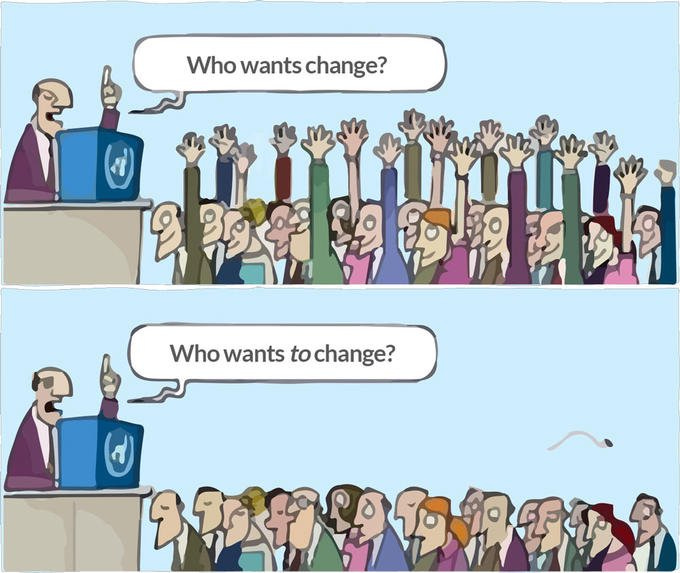
There is both good and bad news for Nevo’s distressful situation.
The good news is that changes in people’s behaviours when it comes to PRs posted on his repo/project will start with him.
The bad news is that changes in people’s behaviours when it comes to PRs posted on his repo/project will start with him.
You could explain that by the cheesy-yet-powerful ‘be the change you want to see in the world’ mantra.
Or you can take a page from the Fundamental Attribution Error theory7.
To quote Malcolm Gladwell talking about it, FAE is the following:
[FAE] is a fancy way of saying that when it comes to interpreting other people’s behavior, human beings invariable make the mistake of overestimating the importance of fundamental character traits and underestimating the importance of the situation and context.8
What it basically says is that the context in which someone operates influences their acts a lot more than their fundamental principles and education. I know it hurts to hear that, but plenty of experiments and studies have confirmed these findings. The most fascinating example is the decline in crime in New York in the late 90s, which occurred as a result of addressing "broken-window" issues such as removing graffiti from subways and improving the overall comfort of the train. Taking actions on “small infractions”, which profoundly changed the perception of what was tolerable and what wasn’t, etc.
So, here is the simple and maybe a bit disappointing conclusion: do not contribute to normalising behaviours that you would find intolerable if used “against” you.
In the specific case of Nevo and Postiz: avoid contributing to the context and conditions that promote slop proliferation if you want to prevent slop from choking your PR review process.
Yes, that might hurt the bottom line, but as I’ve said before, it’s not a principle until it costs you money.


And more importantly, if you disapprove of someone else’s behaviour, start by being a positive role model. The fact that positive role models are becoming increasingly rare in the public space is not helping, which takes us back to FAE.
There lies the choice for Nevo, you, me, and every other person who wishes to actively contribute to creating an environment that’s not built on greed, abuse, and double standards.
I know it might give the impression it actually is, but I have nothing personal against Nevo, its founder and maintainer. This will hopefully become clear as you keep reading through the article.
Call me boomer, but though it’s not infallible, I still trust Wikipedia way more than any chatbot out there. Yes, you need to do a lot of searching and clicking through pages. Yes, you need to engage your brain to make sense of what you read there. Guess what: that’s the point. Oh, BTW, here is the actual page.
I recently heard none other than Cal Newport use the 'AI-washing' term and loved it immediately. In essence, it’s based on the idea that executives will look a lot better if they pretend they’re firing people due to AI advancements rather than recognising they are just correcting for the over-hiring of the pre-2022 years. See also the good article on the topic from David Gerard
I prefer to call it normalisation of deviant behaviour, as it emphasises the behavioural, hence more easily changeable, nature of it. The noun deviance is a bit too fixed-mindset for my taste.
Fun fact: while researching for this article, I discovered the existance of a foundation that goes by that name, focused on saving clownfishes from extinction due to stupid human behaviours. If this isn’t a case of tragedy of the commons I don’t know what it is. This discovery won the serendipitous moment of the week contest.
Careful. This sounds very pretentious. I just came across this very concept in the days preceding me writing the article, in a great book from Malcolm Gladwell. There is clearly a good dose of recency bias here, but this coincidence was also a finalist for the serendipitous moment of the week contest.
Malcolm Gladwell, The Tipping Point. For the record, I’d love to have the same copy editor he has.